



IN THE MARKET? – CLICK BELOW FOR OPEN HOMES THIS SATURDAY



Long before GPS became a standard navigation tool, Roy King was learning to find his way across Moreton Bay by studying its currents, tides and sandbanks. More than five decades later, the Coast Guard Redcliffe veteran’s knowledge of the waters around Scarborough has helped guide rescue searches and train younger volunteers in skills developed through years on the water.
King’s long service came into focus as Coast Guard Redcliffe marked its 53rd anniversary on 25 October 2026. Organisers credited him with 53 years of volunteering, a remarkable contribution that has included rescue operations, medical evacuations, crew training and leadership roles within the organisation.
Knowing where the currents will take you
Finding someone missing at sea involves more than searching the location where they were last seen. Wind, tides and currents can carry a person or vessel away from that position, making local knowledge particularly valuable when planning a search.
King developed an understanding of those conditions through decades of working on Moreton Bay. His familiarity with sandbanks, currents and drift patterns became a resource for other volunteers, particularly when rescue crews needed to determine where to concentrate their efforts.
In a May 2024 profile, fellow volunteer Jonathan Hayes, then identified as a leading coxswain, described King’s ability to guide search operations using his knowledge of the Bay.
Hayes recalled occasions when King directed rescue crews towards areas different from their initial search locations, with missing people subsequently found where he had suggested looking. He also credited King with teaching volunteers how to calculate drift and develop search patterns.

Before electronic navigation became commonplace, King relied on dead reckoning, a method of estimating a vessel’s position using its course, speed and time travelled. By 2024, he was still teaching younger volunteers how to navigate without depending entirely on GPS.
A rescue career that began in the 1970s
King’s association with Coast Guard Redcliffe dates to the organisation’s earliest years, when a group of local boating enthusiasts set about establishing a dedicated marine rescue service on the Peninsula.
The Australian Volunteer Coast Guard’s official history records that the Redcliffe flotilla held its inaugural meeting at Scarborough Marine Centre on 30 July 1973, following a fatal boating accident off Scarborough during the Easter holidays.
A 2024 account of King’s service placed his arrival among the group’s earliest members. It also recorded his involvement in a rescue shortly after joining and described his participation in hundreds of rescue operations during the following decades.
His responsibilities eventually extended well beyond responding to emergencies. King served in positions including flotilla commander, training officer, purser and skipper, with duties spanning rescue coordination, medical evacuations, administration and volunteer instruction.
Although a complete record of his individual missions has not been independently established, his experience covered much of the flotilla’s development from a small volunteer group into a more organised marine rescue operation.


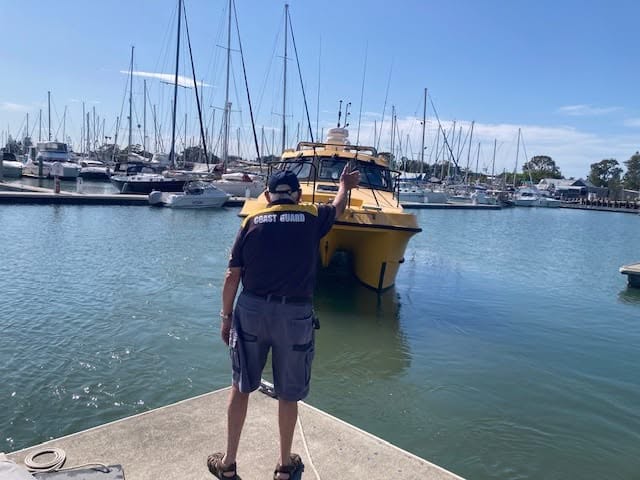
Photo Credit: Coast Guard Redcliffe/Facebook
When the radio room was under a house
King also remembers a time when Coast Guard Redcliffe operated without the facilities and rescue vessels associated with the organisation today.
In his published recollections, the first operations were conducted from a house on Oxley Avenue. Volunteers subsequently established makeshift radio rooms beneath members’ homes before receiving a small shed near Thurecht’s Jetty.


The shed presented its own difficulties. King recalled seawater entering through the wooden floor during high tides, forcing volunteers to keep radio equipment elevated while they continued monitoring communications.
A donated caravan near the Scarborough boat ramp provided another temporary headquarters. King recalled the organisation obtaining its first building in 1980, while the Coast Guard’s official history records the formal opening of its Base and Operations Centre on 1 May 1983.
Resources were equally limited in those early years. According to King’s account, volunteers initially used their own boats, paid for fuel and contributed towards uniforms, training and other expenses.
Fundraising, donations and community support helped keep the service operating. The flotilla eventually acquired its own rescue vessels, including a Nova 1700 launched in December 1976, marking a significant step towards establishing a dedicated rescue fleet.
Passing five decades of experience to younger crews
As King grew older, his contribution increasingly centred on helping other volunteers develop the skills needed for marine rescue.
Hayes described his advice at the base as an important part of search planning. King’s experience allowed him to explain how currents could influence the movement of a missing vessel and why a search might need to shift away from an initially identified position.
His instruction also preserved traditional navigation techniques that newer crews might otherwise encounter mainly during formal training.
In the 2024 profile, King acknowledged missing the experience of going out on rescue call-outs. However, he was comfortable leaving those demanding operations to younger volunteers while continuing to contribute his knowledge.
His reasons for remaining involved were rooted in the friendships developed through volunteering and the satisfaction of helping people without expecting anything in return.
The same account showed that King’s enthusiasm had endured despite the changes he had witnessed. Asked about how much longer he intended to continue volunteering, he offered no definite retirement date.
A lifetime alongside Coast Guard Redcliffe
King’s service has spanned an era of considerable change for marine rescue on the Peninsula, from privately owned boats and improvised radio rooms to dedicated vessels, established facilities and electronic navigation.
The flotilla’s 53rd anniversary on 25 October provided an opportunity to recognise that history, with organisers identifying King among its longest-serving volunteers. The celebrations came as the organisation prepared for a proposed November transition to Marine Rescue Queensland, following a statewide agreement announced in May.
For King, however, the most enduring part of his contribution may be the experience passed from one crew to another. His knowledge of Moreton Bay’s currents, sandbanks and search patterns has helped younger volunteers understand the waters they may one day be called upon to search.
Long after navigation equipment changed the way rescue vessels operate, the lessons King learnt on the Bay have continued to find their way into the hands of the next generation.
Published 26-Oct-2026


CLICK ANY LOGO TO SEE PUBLICATION