


IN THE MARKET? – CLICK BELOW FOR OPEN HOMES THIS SATURDAY



The Dolphins’ 26-24 win over the Warriors was the sort of game that would have slipped away from them not so long ago.
There were reasons for it to turn. The Warriors kept coming. The scoreboard tightened. Isaiya Katoa left with a wrist injury. A side that had built its season on rhythm suddenly had to finish one of its biggest games of the year without the young halfback who has increasingly become its on-field organiser.
Yet when Selwyn Cobbo crossed late, it felt less like a stolen result than a reflection of where the Dolphins have moved as a football team.
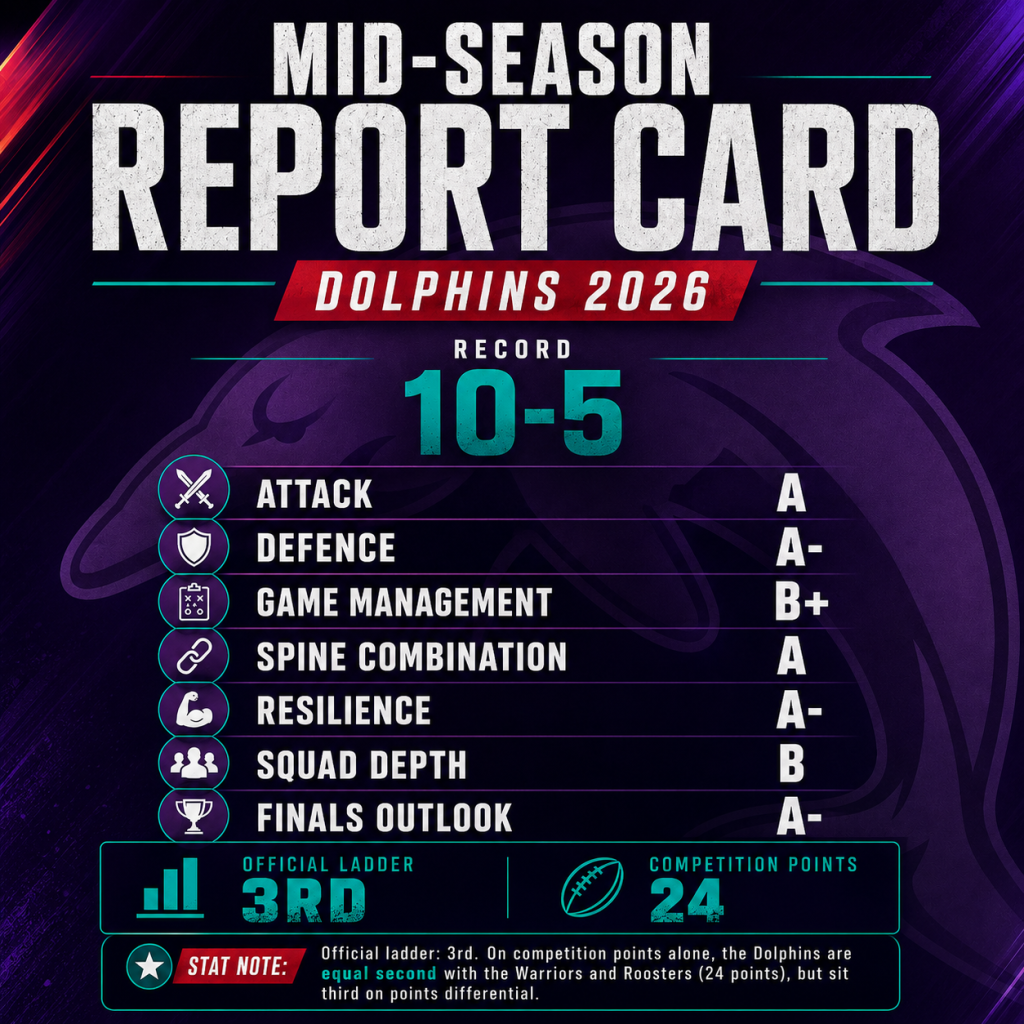
They are no longer a dangerous side that can catch better teams on the wrong afternoon. They are third on the ladder after 17 rounds, sitting on 24 competition points with the Warriors and Roosters, and their 10-5 record has made the conversation around them shift. A top-four finish is no longer being discussed as a nice story. It is now the standard they have given themselves.
The Bennett Inheritance, The Woolf Adjustment
Kristian Woolf did not walk into a broken football club. That matters.
Wayne Bennett gave the Dolphins their first identity: hard to embarrass, difficult to bully, clear about what they would and would not accept. Expansion teams often spend years trying to find that. The Dolphins had it almost immediately.
Woolf’s success has come from understanding what did not need to be pulled apart.
He inherited standards, but he has not simply preserved them. The football has developed. The Dolphins now look less reliant on emotion and more comfortable winning through method. Their better performances have not all looked the same, which is usually a sign of growth. They can trade points when the game opens up, but they have also become more willing to stay in the grind, kick to the right areas, back their defensive line and wait for the game to offer them something.
That is where Woolf’s influence is most visible. The Dolphins still carry the edge Bennett built into them, but they are playing with more patience. They do not need every set to become a statement.

A Side Learning To Trust Its Defence
After the Warriors win, Woolf summed up the shift neatly.
“When you defend like that, you eventually get your opportunities with the ball.”
That has become one of the more important ideas in their season because it explains how their football has matured. Earlier in their rise, the Dolphins were at their most comfortable when their attack was rolling. Quick play-the-balls, support through the middle, speed on the edges and enough instinct around the ball to worry any defensive line.


Now, there is a little more steel underneath it.


Their defensive improvement is not just about effort, although there has been plenty of that. It is in the way they are staying connected after fatigue. Their edges are not leaving as many easy decisions for opposition halves. Their middles have become better at absorbing pressure without immediately giving away cheap yardage penalties. When they lose field position, they are more prepared to defend two or three sets rather than chase the miracle play that gets them out of trouble.
The Warriors comeback still showed the risk. Momentum can still move quickly against them, particularly when the Dolphins lose control of the ruck or let an opposition side play off second phase. But the important part is that they did not panic. They were forced to finish the game in uncomfortable circumstances and still found enough composure to win.
That is usually what separates a top-four side from a team hovering around the bottom of the eight. Good teams have attacking weapons. The better ones know how to survive when those weapons are not getting clean looks.
Katoa Is No Longer Just The Future
Katoa’s development has probably changed the ceiling of this side more than anything else.
There were always flashes. The pass selection, the confidence to play short, the ability to move defenders with his eyes. This year, the more impressive part has been the quieter work. His kicking game has become more purposeful. He is not just ending sets; he is shaping the next one. He has learned when to keep hammering a corner, when to turn a winger around, when to resist the temptation to overplay simply because the Dolphins have strike outside him.
His partnership with Kodi Nikorima has helped. Nikorima gives the Dolphins tempo and instinct, but he is no longer being asked to carry the whole creative load. Katoa’s calm has allowed Nikorima to play in bursts, to straighten the attack when the defence is retreating and to pick moments rather than force them.
Around them, the backline has started to look properly balanced.
Herbie Farnworth gives the Dolphins a centre who can win a collision and still make the right pass. Jamayne Isaako remains one of their most reliable finishers and a valuable pressure player because of what his goal-kicking does to close games. Hamiso Tabuai-Fidow changes defensive spacing simply by being in motion. Cobbo, meanwhile, gives them a different kind of threat: size, reach, yardage out of trouble and the ability to decide a game late without needing a perfect attacking shape.
None of that works if the halves are frantic. Katoa’s importance is that he has made the Dolphins’ dangerous players easier to use.
That is why his wrist injury will be watched so closely. The Dolphins have depth, and they have experience around him, but replacing a halfback who has become central to their timing is never straightforward.
Why Third Is Only Part Of The Picture
Third place tells a flattering story, but not the whole one.
The Dolphins are level on 24 points with the Warriors and Roosters. The difference is margin. The Warriors sit second with a points differential of +168, the Dolphins are third at +131, and the Roosters are fourth at +60. That gap matters because the ladder is tight enough for points differential to become more than decoration.
It may decide who gets a home final. It may decide who avoids a more difficult Week One path. It may even decide whether a strong season is rewarded properly.
The Panthers have put some air between themselves and the chasing pack on 28 points, but behind them the squeeze is real. Manly are on 22. South Sydney and Cronulla are also on 22 with games in hand. That is why the Dolphins cannot treat narrow wins and missed chances as separate issues. Winning remains the first job, but the sides around them have left very little room for waste.
In that sense, the Warriors result did two things. It gave the Dolphins competition points against a direct rival, and it stopped the Warriors from stretching further away. At this time of year, that double effect matters.
The Parts Still Needing Attention
The Dolphins are not a finished product, and that is not a criticism.
Their challenge is to reduce the number of periods where games suddenly become too fast for them. The Warriors nearly dragged them into that territory. Once the Dolphins lost some control through the middle, the match started to feel less like a game they were managing and more like one they had to rescue.
That cannot become a habit.
The Origin period also asks different questions. Cobbo, Tabuai-Fidow and other representative-class players give the Dolphins genuine top-end quality, but the same strength can test continuity. Managing bodies, training loads and short turnarounds becomes part of the football. So does making sure the side’s defensive habits do not depend on everyone being fresh.
Katoa’s injury sits at the centre of the next fortnight. If he misses time, the Dolphins will need to simplify without becoming predictable. Their kicking game, last-play options and right-edge timing all become areas to monitor.
Two Games That Will Tell Us Plenty
Newcastle away in Round 18 is the sort of match good sides are expected to handle, which is exactly why it carries danger.
The week after a high-emotion win can be awkward. The Dolphins have just beaten a top-four rival in a match with finals weight. Backing that up on the road against a side with less ladder pressure but plenty of capacity to make the game ugly will test their maturity.
Then comes Cronulla at home in Round 19.
That one is impossible to separate from the top-four race. The Sharks are two points behind with a game in hand, so the Dolphins will understand the value of keeping them at arm’s length. A home win would not settle anything, but it would make Cronulla’s chase much harder and strengthen the Dolphins’ grip on a finals advantage.
Lose it, and the table tightens again.
That is the difference now. The Dolphins’ games are no longer being measured by whether they can surprise the competition. They are being measured by what they do to the shape of the top four.
They have earned that shift.
The next part is less romantic. It is about managing injuries, defending through tired patches, banking results away from home and turning Kayo Stadium into the kind of venue rivals do not want to visit in July and August.
The Dolphins are no longer trying to prove they belong among the NRL’s best.
They are trying to stay there.
Published on 28 June 2026


CLICK ANY LOGO TO SEE PUBLICATION