

IN THE MARKET? – CLICK BELOW FOR OPEN HOMES THIS SATURDAY



When a Brisbane mother described being followed by a car in the dark during her morning run, the responses flooded in — including one from Jan, a Redcliffe resident who has led an active life for more than six decades and made a simple decision long ago: she would never run alone in the dark.
“When I was doing team sports we used to all train as a pack,” Jan said. “And that’s the only way you could do it. And that’s been going on for 60 years.”
When a routine run became frightening
Kate, a mother of two from the Redlands, was on her regular 5:30am run when a car began following her through the dark streets. The driver wound down the window and said things she described as “very awful.” It was not her first experience of harassment while running, but it was the first time she feared she might not make it home.
She escaped by running toward nearby shops, which spooked the driver into leaving. Reporting the incident proved almost as distressing. Three phone calls and three police officers later, someone finally took her details. She had reported a similar incident previously and was told the man was “harmless.”
A problem researchers have been documenting for years
Jan’s experience of training in groups for safety is not a personal quirk — it reflects a pattern documented in research across the running community.
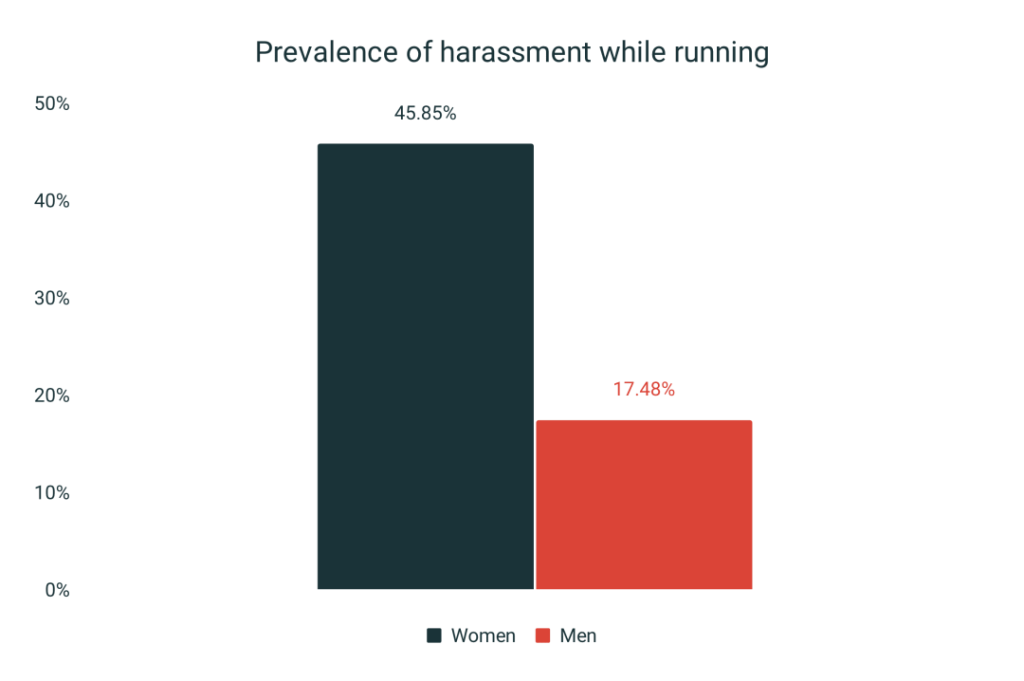
A survey of 4,709 runners found that 45.85 per cent of female runners had experienced harassment, with women 2.62 times more likely to be harassed on a run than men. Of those women, more than 80 per cent changed their running habits as a result.
UK research found up to 84 per cent of women runners in London had experienced harassment, and a 2021 Runner’s World survey of 2,000 female runners found 60 per cent had experienced some form of harassment.
In Australia, the Personal Safety Survey found one in two women had experienced sexual harassment in their lifetime — more than twice the rate for men.

“I don’t feel like there’s any really safe place now”
Newstead run club founder Katie Dall, who started the Club KT Walk Run Club in 2021, said harassment of female runners in Brisbane happened frequently. “I don’t feel like there’s any really safe place now,” Dall said. “Even during the day you have to be careful.” She has had her own experience of a car slowing beside her near New Farm Park, leaving her calculating her next move in real time.
Dall is reluctant to tell women where they can and cannot run. “I don’t like to say to women, ‘Don’t run there’, because why should we have to change our behaviour?” she said.
The onus is not on women
University of Melbourne associate professor of criminology Bianca Fileborn said that framing — safety tips for women — missed the point. “The emphasis needs to be on the people or the men who are engaging in this behaviour in the first place,” she said. Telling women to carry a phone or share their location could help them feel safer, but there was little evidence it actually reduced risk.


“Women and girls are routinely having to evaluate what the right amount of panic is, to direct their movements and actions in public spaces,” Deakin University Senior Lecturer in Criminology Dr Mary Iliadis wrote in analysis of the issue. The solution, researchers consistently argue, lies in challenging the social and structural drivers of gender-based harassment — not in managing women’s behaviour around it.


For anyone wanting to connect with other runners for safety or community, the Club KT Walk Run Club operates out of Newstead and can be found at clubkt.com.au.
Published 8-July-2026


CLICK ANY LOGO TO SEE PUBLICATION