

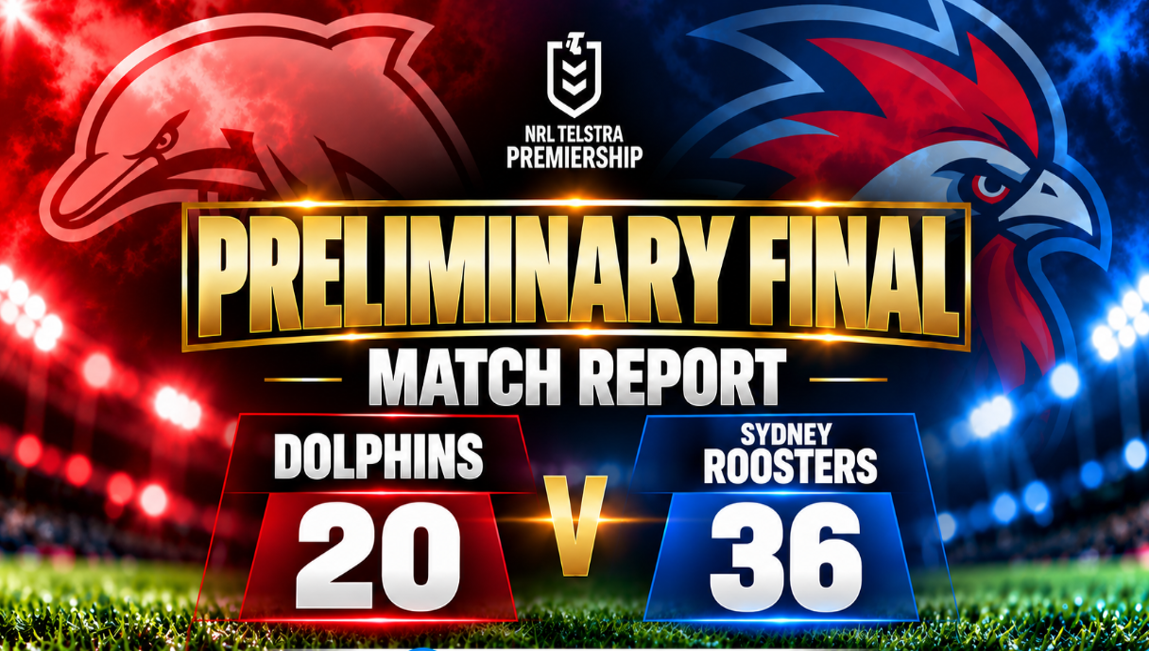
Brave Dolphins Downed by Ruthless Roosters

The 18th-minute turnaround that saw a Selwyn Cobbo overlap turn into an interception from Herbie Farnworth’s pass, with Marky Mark going the length of the field to open the scoring for the Roosters, was a classic example of how this game went.

At 16-0 down after 2 more Roosters tries, the Dolphins scrapped their way back into the game at 16-10, but the Ruthless Roosters combined huge defence with some brutal finishing to earn their place in the Grand Final at the expense of the Brave Dolphins.

The 52,000 at Suncorp, a vast majority being Dolphins fans, were left stunned by how the Sydney side sucked the wind from the Phins sails, but the Dolphins have plenty to be proud of, after a season when they proved themselves to be worthy premiership challengers.

The Phins reduced the deficit from 36-10 to 36-20 but it was too little, too late.


Sydney Made Their Chances Hurt

The final numbers were much closer than the score. Possession finished 50–50, both sides completed at 83 per cent and the Dolphins actually had more runs, 184 to 166. The difference was what Sydney did when the defensive line cracked.

That danger had been identified in the match preview. The Dolphins needed to control field position, limit Sydney’s kick returns and avoid giving a dangerous attack repeated opportunities. They had survived those moments in their 26–12 win over the Roosters in Round 26; on Friday night, Sydney punished them.

Nawaqanitawase’s opening try was followed by Victor Radley and Daniel Tupou before the half-hour mark, turning a competitive start into a 16–0 deficit.

Isaako Gives Suncorp Hope
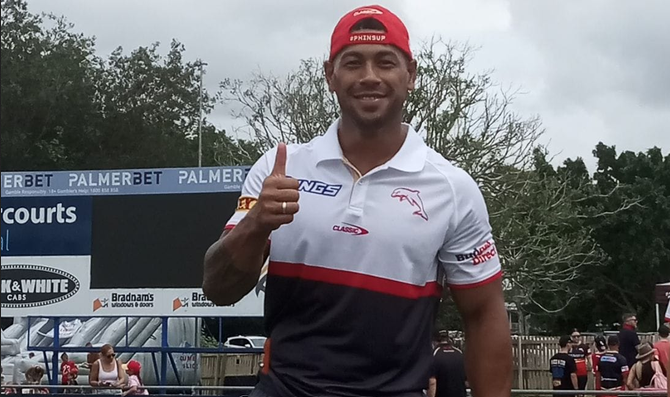
Jamayne Isaako
Jamayne Isaako. Photo credit: Sampajanna/Wikimedia Commons, CC0

Jamayne Isaako’s 33rd-minute try gave the Dolphins a foothold before half-time. When he crossed again barely two minutes after the restart, suddenly it was 16–10 with most of the second half remaining.

For a side that had repeatedly found ways back into games during its eight-match winning run, this was the moment. The Dolphins had absorbed Sydney’s damaging carries, survived the early burst and were one converted try away.

Sydney’s response decided the game.

The Roosters Answer

Robert Toia crossed in the 46th minute, Lindsay Collins followed eight minutes later and Nawaqanitawase added his second before Sam Walker went through in the 66th. In a little over 20 minutes, a six-point game had become 36–10.

It wasn’t simply a matter of Sydney having more football. The Roosters finished with 1,781 run metres to 1,554, 600 post-contact metres to 512 and eight line breaks to four. The Dolphins were getting less return from comparable possession, while Sydney were brutally efficient when space appeared.

Where The Game Was Won

That also made Isaiya Katoa’s job harder than it had been against the Warriors. In Auckland, his long kicking game helped the Dolphins patiently work their way back from eight points down. This time, every comeback brought another Sydney response and the scoreboard increasingly forced the Dolphins to chase the game.

The Roosters kicked for 632 metres to 593 and generated 215 kick-return metres to the Dolphins’ 155. They didn’t dominate every measure, but they won enough of the territorial exchanges and were far more damaging once they got the Dolphins’ defence moving.

The 45 missed tackles by the Dolphins, compared with Sydney’s 33, were another indication of the physical toll.

Isaako Passes 300

There was still a significant personal milestone on a difficult night. Isaako entered the preliminary final on 298 points for the season, and his conversion after his first try took him beyond 300.

He finished with two tries and two conversions, his second try briefly bringing the Dolphins within six before Sydney took the game away.

They Kept Coming

Even at 36–10, the Dolphins kept playing. Kulikefu Finefeuiaki crossed in the 74th minute before a Cobbo line break helped create Farnworth’s try two minutes later, with Isaako’s conversion completing the 36–20 scoreline.

It was too late to change the result, but it was consistent with a side that had spent the back end of the season refusing to disappear from contests.


A Season That Changed Expectations

The Dolphins entered Friday night on an eight-game winning streak at Suncorp and playing their first preliminary final, just four seasons after joining the NRL. Their first finals campaign ends one victory short of a Grand Final, beaten by a Roosters side that was simply more clinical when the match presented its decisive moments.

After the game, City of Moreton Bay Mayor Peter Flannery said the disappointment of the loss had not diminished what the Dolphins had achieved.

“It just wasn’t our night tonight, but we are so incredibly proud of the boys and their Phin-enomal achievement this year.

“The Dolphins’ journey to this moment has inspired not just the people of our City of Moreton Bay, but the entire NRL.”

For the Dolphins, 2026 changed the measure of what constitutes success. September is no longer somewhere they are trying to reach. It also changed expectations about what might come next.

Flannery said the finals run had “galvanised the City of Moreton Bay” and added: “Now we dare to dream what’s possible in 2027.”

They have shown they belong there.

Published 25-September-2026
The Dolphins Are One Win From a Grand Final. This Didn’t Happen Overnight

Four seasons into their NRL life, the Dolphins are 80 minutes from a Grand Final. The way they got there — coming from behind to beat the Warriors 26–16 in Auckland in their first finals appearance — told a story that began long before Saturday.

There were plenty of moments at Go Media Stadium when the night could have got away from them.

Tom Flegler was gone inside the opening 10 minutes with concussion. Penalties piled up, tempers flared and players went to the sin bin. By the 52nd minute the Warriors led 16–8, with 10 of those points coming from penalty goals, and the Dolphins had spent long stretches fighting the game rather than playing it.


READ: Dolphins Beat Warriors 26–16 to Reach Preliminary Final


Isaiya Katoa had seen that movie before. He went straight back to Round 23 last year after the final siren, recalling the ugly afternoon against the Roosters when an early melee and four sin-binnings accompanied a 64–12 defeat.

“One thing for us is we took a lot of lessons out of last year,” Katoa said. “We just never were able to go back and play our footy.”

In Auckland, with another game becoming heated, Katoa’s message to his teammates was simple: “Winning a fight or winning a push and shove on the field is not going to win the result at the end of the game.”

This time they found their way back to the football.

Some Lessons Take a Couple of Seasons

That ability to regain control hasn’t always been there.

The Dolphins arrived in 2023 capable of giving established sides plenty of trouble and showed it again during 2024. The harder part was sustaining their best football, both through individual matches and across an entire season.

Former foundation forward Mark Nicholls put it plainly before the 2025 campaign. “We’ve been there early in the year and then fell away at the back end,” he said.

Nicholls also remembered “plenty of games” when the Dolphins had been in front at half-time but “just couldn’t get the job done”.

Both of those first two seasons ended before the finals. The 2025 Roosters loss provided another harsh lesson, one Katoa was still drawing on more than a year later.

Auckland gave him the chance to use it.

Then Katoa Changed the Game

Eight points down, the Dolphins didn’t suddenly produce some elaborate rescue act. They started playing the game where they wanted it played.

Katoa’s long kicking turned the Warriors around and the field began to open. Hamiso Tabuai-Fidow and Herbie Farnworth combined spectacularly to put the Dolphins ahead, before Jack Bostock’s late try finally broke the resistance.

From 16–8 down after 52 minutes, they scored the last 18 points. The Warriors didn’t score again.

Kristian Woolf had watched that sort of resolve develop during the run home. “The bravery they showed under pressure, they’ve done that so many times at the back end of the season,” he said afterwards. “They’re in this position for a reason.”

For once, the Dolphins don’t have to immediately prove him right again. Their reward for winning in Auckland is a weekend away from the collisions while the rest of the finals field gets smaller.


READ: Four Years to September: How the Dolphins Built Their First Finals Team


Suncorp Is Waiting

Whoever survives to meet them will arrive in Brisbane with their season on the line. So will the Dolphins.

There is no history to fall back on from here. They have never played a preliminary final, much less a Grand Final, and the hardest 80 minutes of their season may still be ahead.

What they do have is four seasons of experience packed into a remarkably short life as an NRL club — the fast starts, the games that slipped away, two Septembers spent watching and the occasional afternoon they would rather forget.

Saturday in Auckland belongs on the other side of that ledger.

The Dolphins went there for their first final, fell eight points behind and found a way out. Now they come home, one win from a Grand Final.

Published 15-September-2026

Dolphins Beat Warriors 26–16 to Reach Preliminary Final

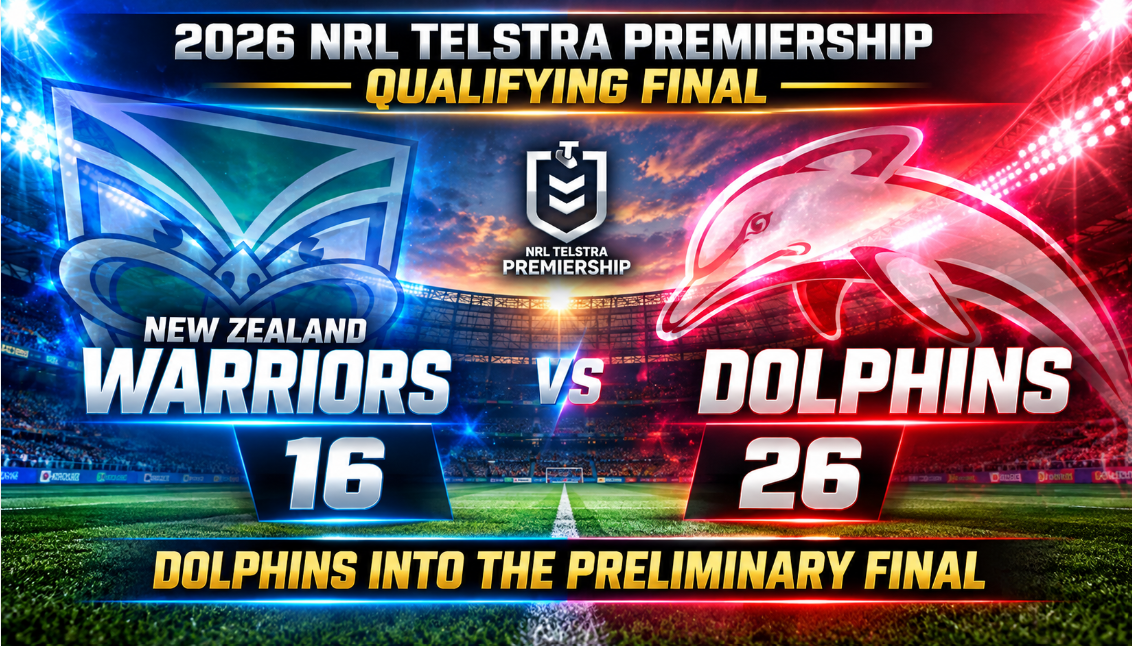
The Dolphins are through to a preliminary final after turning an eight-point second-half deficit into a 26–16 win over the Warriors in Auckland, extending their remarkable late-season run to eight straight victories.

For almost an hour, their first NRL final was a grind. The Warriors had the crowd behind them, a lead on the scoreboard and Taine Tuaupiki steadily adding points from the kicking tee, while the Dolphins struggled to turn their opportunities into enough scoreboard pressure.

That changed in the final quarter. Herbie Farnworth crossed in the 60th minute, Hamiso Tabuai-Fidow followed six minutes later and Jack Bostock added another in the 74th, transforming a 16–8 deficit into a 26–16 victory.

It was not the free-flowing afternoon their recent scoring form might have suggested. The Dolphins instead had to stay with a finals match that became messy and frustrating before their attacking players finally found the openings they needed.


Warriors Keep the Scoreboard Moving

New Zealand were happy to take points whenever the Dolphins gave them the opportunity. Tuaupiki kicked an eighth-minute penalty before Jamayne Isaako answered four minutes later, then scored the opening try in the 15th minute and converted it himself.

Another Tuaupiki penalty made it 10–2 before Selwyn Cobbo gave the Dolphins their first try in the 25th minute. Isaako converted and, despite New Zealand having controlled much of the opening quarter, the margin was back to two.

The game then entered a chaotic stretch. Adam Pompey was sent to the sin bin in the 28th minute before Kurt Capewell and Cobbo were both binned five minutes later. Isaiya Katoa was also placed on report during the same passage.

Very little scoring came from all that disruption. Tuaupiki’s penalty on the stroke of half-time was the only further addition, sending the Warriors to the sheds 12–8 ahead.

That was largely how New Zealand had built their advantage. The teams had scored one try each, but the Warriors kept taking the two points on offer and making the Dolphins chase them.

Dolphins Stay Within Reach

The Dolphins’ habit of conceding starts had been one of the concerns heading to Auckland after their huge recoveries against Brisbane and Gold Coast. This time the deficit never became quite as alarming, although they again spent a long period playing from behind.

Tuaupiki kicked two more penalties early in the second half, stretching the Warriors’ lead to 16–8 by the 53rd minute. New Zealand had now kicked five penalty goals but still had only one try, leaving the Dolphins close enough for one productive attacking spell to change the match.

Farnworth provided it in the 60th minute, breaking through for a try that Isaako converted to make it 16–14. Six minutes later Tabuai-Fidow found his way through and Isaako’s conversion put the Dolphins ahead for the first time at 20–16.

After spending most of the afternoon trying to get back on terms, the Dolphins suddenly had New Zealand chasing them. The game had also opened enough for their dangerous runners to become a much bigger factor.

Bostock Puts It Beyond Reach

There was still plenty of time for New Zealand at 20–16, but the Dolphins looked increasingly threatening once they had the lead. Bostock had already broken the Warriors line earlier in the half and, in the 74th minute, he crossed for the try that effectively settled the contest.

Isaako’s conversion took the score to 26–16 and completed a faultless afternoon from the tee. He kicked four conversions and a penalty goal, while Cobbo, Farnworth, Tabuai-Fidow and Bostock shared the Dolphins’ four tries.

New Zealand’s scoring had a very different shape. Tuaupiki accounted for all 16 Warriors points with their only try, a conversion and five penalty goals.

Those twos had been enough to keep the Dolphins at arm’s length for much of the afternoon. Once Farnworth and Tabuai-Fidow struck six minutes apart, however, the Warriors needed tries of their own and could not find them.


A Win With Some Rough Edges

The Dolphins did not come through the afternoon without concerns. Thomas Flegler left for an HIA inside the opening 10 minutes and did not return, while Kodi Nikorima and Connelly Lemuelu were both placed on report during the second half.

Discipline also helped the Warriors accumulate their five penalty goals, and the three first-half sin bins made an already tight contest difficult to settle. Against a side able to turn more of those opportunities into tries, the Dolphins could have faced a much steeper climb.

What mattered in Auckland was that they never allowed the Warriors to get far enough away. An eight-point deficit after 52 minutes did not force them to abandon their game, and when the chances came, the players who have driven much of their late-season surge took them.

Farnworth brought the Dolphins back within two, Tabuai-Fidow put them ahead and Bostock gave them the breathing room they needed to see out the afternoon.

Eight Straight and Into the Final Four

Before the match, Auckland presented a different test of the run that had carried the Dolphins to third place. They had won seven straight, but none of those games had involved finals pressure or a trip to a ground where the Warriors had lost only twice all season.

Their eighth win looked different from many that came before it. They spent most of the match behind, lost Flegler early and had to negotiate a contest punctuated by penalties, sin bins and long periods when the Warriors controlled the scoreboard.

The decisive passage came after the hour mark. Farnworth scored in the 60th minute, Tabuai-Fidow in the 66th and Bostock in the 74th, turning an eight-point deficit into a 10-point win.

The Dolphins will now sit out next weekend before returning for a preliminary final, one victory away from a grand final appearance.

Four seasons into their NRL life, their first finals match has ended with their first finals win.

Published 12-September-2026

The Road to the Grand Final: Your 2026 Dolphins Finals Guide

Four seasons after entering the NRL, the Dolphins are heading into September from third place, with their first finals assignment taking them across the Tasman to face the second-placed New Zealand Warriors.

The qualifying final at Go Media Stadium on Saturday, 12 September offers a direct route deep into September. Win in Auckland and the Dolphins move straight into a preliminary final with a week off; lose and the double chance earned through their top-four finish keeps their season alive.

After spending their first three seasons trying to reach September, the Dolphins have finally arrived. What matters now is how far they can go.

Week One: Warriors v Dolphins

Qualifying Final
New Zealand Warriors (2nd) v Dolphins (3rd)
Saturday, 12 September
Go Media Stadium, Auckland
4.05pm AEST / 6.05pm NZ time

Both sides arrive in serious form. The Dolphins have won seven consecutive matches and the Warriors six, setting up a qualifying final between two teams carrying genuine momentum into September.

They Already Know How Close This Can Get

Their only meeting this season provided a fair indication of how little may separate them.

The Dolphins won 26–24 at Suncorp Stadium in Round 17 after Selwyn Cobbo scored late and Jamayne Isaako converted from the sideline. That gives them evidence they can break down the Warriors, although repeating it in Auckland under finals pressure is a different assignment.

The Warriors have home advantage and a powerful middle capable of restricting the Dolphins’ attacking freedom, making the contest for field position particularly important.

Three Matchups That Could Shape It

The Battle Through the Middle

James Fisher-Harris, Mitch Barnett and Erin Clark give the Warriors considerable experience and physicality through the middle. The Dolphins have plenty to answer with, but they need to earn the field position that allows their strike players to become influential.

If the Warriors consistently force the Dolphins to begin sets deep in their own half, Isaiya Katoa could spend much of the afternoon kicking from poor positions. Give him a platform further upfield and the complexion of the game changes quickly.

Katoa and the Kicking Game

Finals football places a premium on completing sets, finding grass and forcing opponents to work out of their own end, putting considerable responsibility on Katoa.

The 22-year-old has become increasingly important to the Dolphins’ attack, but Auckland may test his patience as much as his creativity. Against a Warriors side capable of punishing poor field position, knowing when to play conservatively could be as important as producing the spectacular.

Finding Space for the Strike Players

Hamiso Tabuai-Fidow and Herbie Farnworth give the Dolphins the ability to turn ordinary passages into points, while the wider backline provides Katoa with threats across the field.

The Titans saw that danger in Round 27, when the Dolphins recovered from 14–0 down to win 24–20 and Tabuai-Fidow scored twice while running for 261 metres. It was another demonstration of their attacking capacity, although repeatedly relying on recovery football would be a dangerous habit to carry into September.

The Selection Questions

The official Week One team is still to be named, with three players in particular to watch.

Cobbo missed the Titans match with an ankle problem, Kodi Nikorima was withdrawn with hamstring tightness and Kulikefu Finefeuiaki sat out with a knee issue. All three are currently listed by the NRL as targeting a return during the finals.

Their availability would bring the Dolphins considerably closer to the combinations used during their late-season run, but until the team is named, their Week One selection should not be treated as certain.

Seven Straight Into September

The Dolphins could hardly ask for a stronger form line. Seven consecutive victories have carried them into their maiden finals campaign, including wins over Parramatta and the Roosters before the 24–20 comeback against Gold Coast.

The Titans match was hardly a flawless tune-up. Gold Coast raced to a 14–0 lead inside 16 minutes and threatened again late, forcing the Dolphins to regain control and then withstand pressure to close it out.

There may be some value in having faced that immediately before the finals, but it also reinforced a concern that has followed the Dolphins through their winning run.

The Double Chance — and Why It Matters

Finishing third means defeat in Auckland would not end the Dolphins’ season. They would instead move into a sudden-death semi-final in Week Two against the winner of the Sharks-Cowboys elimination final.

Victory is far more valuable. Beat the Warriors and the Dolphins skip Week Two entirely, gaining an extra week to recover before playing a preliminary final for a place in the Grand Final.

The shortest route therefore requires three victories from here: Warriors, preliminary final, Grand Final. Lose in Auckland and an additional sudden-death match is added to the journey.

Five Reasons the Dolphins Can Go Deep

The case for the Dolphins as premiership contenders has already been built across the regular season, but several strengths matter particularly now.

Tabuai-Fidow and Farnworth provide elite strike power, while Katoa has grown increasingly comfortable directing the side. There is enough size and experience through the forwards to compete when finals football tightens up, and seven consecutive victories provide compelling evidence of current form.

Then there is their resilience. Brisbane led the Dolphins 24–0 in Round 23 before losing 40–32, while Gold Coast led 14–0 in Round 27 and lost 24–20.

Those comebacks are evidence of a team that is difficult to put away. They also point directly towards its biggest vulnerability.

The Biggest Obstacle

The Dolphins have developed an uncomfortable habit of showing how dangerous they are after making life considerably harder for themselves.

Recovering from 24 points down against Brisbane produced one of their most memorable wins of the season, and the Titans comeback sent them into September on another high. Against the strongest sides in the competition, however, those deficits can become too large to retrieve.

Their attacking talent gives them unusual capacity to rescue matches. In the finals, avoiding the need for a rescue in the first place may be more important.

What It Could Come Down To

The Warriors earned the advantage that comes with finishing second, and Auckland is about as demanding an assignment as the Dolphins could have drawn for their first finals appearance. They also enter September with six consecutive victories, so neither side has much reason to fear the other’s form.

The Dolphins have already shown they can beat this opponent, but doing it again will require something they have not always managed during their late-season surge: producing their best football without first putting themselves in trouble.

Get that part right and the reward is substantial. A victory in Auckland would deliver a week off and leave the Dolphins one win from the Grand Final.

For a club entering its first finals campaign only four seasons after joining the NRL, that is already remarkable territory. From here, though, the story is no longer about how quickly the Dolphins got here.

It is about what they do now.

Published 7-September-2026

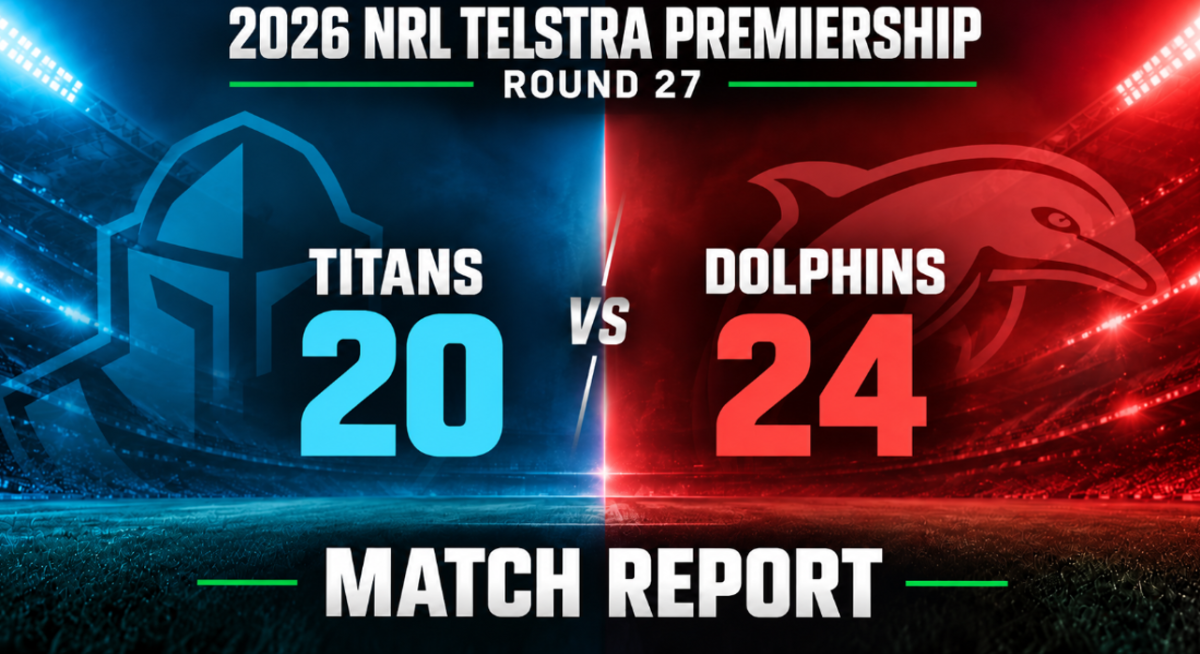
Dolphins Fight Back From 14 Down to Beat Titans Before Finals

The Dolphins stared down a 14-point hole on the Gold Coast and came roaring back, beating the Titans 24–20 to carry winning momentum into the club’s first NRL finals campaign.


Gold Coast had them 14–0 down inside 16 minutes and threatening to turn the final night of the regular season into an uncomfortable one. By half-time, though, the Dolphins had dragged themselves back to 14–12 before two quick tries after the break completed the turnaround.

It wasn’t the performance of a top-four side cruising towards September. What mattered was how the Dolphins responded once the Titans had put them under genuine pressure.

Gold Coast Lands the First Punches

Playing his 100th NRL game, Jayden Campbell crossed after six minutes before AJ Brimson added another in the 10th. Campbell converted both and then kicked a penalty goal to give the Titans a 14–0 advantage.

The Dolphins, with Kodi Nikorima, Kulikefu Finefeuiaki and Selwyn Cobbo all given the night off as Woolf took a cautious approach ahead of the finals, had made a mess of the opening quarter and were suddenly chasing the game.

Their opportunity arrived when Keano Kini was sin-binned in the 23rd minute, and they didn’t waste it. Hamiso Tabuai-Fidow crossed less than two minutes later, Herbie Farnworth followed in the 28th and Jamayne Isaako converted both to cut the deficit to 14–12 at the break.

Twenty-Four Unanswered Points Change the Game

Rather than losing momentum at half-time, the Dolphins came out and finished the comeback almost immediately.

Ray Stone crossed in the 45th minute after Francis Molo broke the Gold Coast line, putting the visitors ahead for the first time. Two minutes later Tabuai-Fidow was through again and, with Isaako maintaining his perfect night from the tee, a 14-point deficit had become a 24–14 lead.

It was the Dolphins at their most dangerous. Once they found some rhythm, four tries arrived in a little over 20 minutes.

What followed was less convincing, with errors preventing them from putting Gold Coast away and giving the Titans enough possession to stay in the contest. Campbell eventually crossed for his second try in the 71st minute and converted to make it 24–20.

The final minutes became a scramble rather than a procession. Isaako was placed on report following a tripping penalty, while Titans prop Moeaki Fotuaika was sin-binned and placed on report late as Gold Coast searched for a way to steal the match.

They couldn’t find it.

A Win With a Warning Attached

There is plenty for Kristian Woolf to take from the comeback, but probably just as much from the way the Dolphins got themselves into trouble.

Giving a Titans side that entered the round in 16th a 14-point start was an obvious concern, while the errors that followed the second-half surge allowed a game the Dolphins appeared to have taken over to remain alive until the closing minutes. September is unlikely to offer the same margin for recovery.

Still, Tabuai-Fidow’s double again showed how quickly this attack can change a match. Farnworth continued his late-season scoring form, while Isaako’s four conversions ultimately made the difference in a four-point result.

There was a little history attached to the win as well. The Dolphins had won each of their previous three matches against the Titans at Cbus Super Stadium, so their perfect record there against Gold Coast now stands at four from four.

More significantly, the regular-season climb that began with their NRL debut in 2023 is complete. Finishes of 13th, 10th and ninth have now given way to a top-four season and the club’s first appearance in September.


The Dolphins won’t want to take Friday night’s opening 20 minutes with them. The ability to recover from it, however, might be worth packing.

Titans 20
Tries: Jayden Campbell 2, AJ Brimson
Goals: Jayden Campbell 3 conversions, 1 penalty goal

Dolphins 24
Tries: Hamiso Tabuai-Fidow 2, Herbie Farnworth, Ray Stone
Goals: Jamayne Isaako 4 conversions

Half-time: Titans 14–12 Dolphins
Venue: Cbus Super Stadium, Gold Coast
Round: 27, 2026 NRL Telstra Premiership

Published 4-September-2026

Can the Dolphins Actually Win the 2026 Premiership?

This wasn’t supposed to become a premiership conversation quite so quickly. Four seasons into their NRL life, the Dolphins have already secured a top-four finish and will play finals football for the first time.

Making September was the breakthrough, but the way this season has developed has pushed the conversation considerably further. Around Redcliffe, there is now a much more intriguing question to ask: can the Dolphins actually win the thing?

There is enough evidence to take the possibility seriously, without pretending there aren’t weaknesses that could bring the whole run undone.

An Attack Built to Hurt the Best

The Dolphins have attacking threats everywhere. Isaiya Katoa has 16 try assists from 19 appearances and increasingly controls the way this team plays, while Hamiso Tabuai-Fidow can open a game from almost anywhere and Herbie Farnworth has combined 12 tries with 143 tackle breaks this season.

Then there is Jamayne Isaako, Selwyn Cobbo and Kodi Nikorima, with a forward pack capable of creating the room for all of them. Give the Dolphins momentum and there aren’t many comfortable places for a defensive line to look.

But we knew they could score. The Dolphins led the NRL with 721 points last season and still finished ninth because too much of that attacking work was being given back at the other end.

That’s why some of the most encouraging signs in 2026 have come without the ball.

The Roosters Win Told Us Something Different

The 26–12 win at Allianz Stadium last weekend wasn’t another afternoon of the Dolphins simply running somebody off the park. Tom Flegler and Morgan Knowles were both sin-binned, briefly reducing them to 11 men, and suddenly the afternoon became as much about scrambling and surviving as scoring.

They handled it. Max Plath forcing Siua Wong into touch was one of several defensive moments that won’t dominate the season highlights, but collectively they said plenty about how this team has changed.

A year after defence helped keep the Dolphins out of September, they had just won a significant late-season game partly because of it. For their premiership prospects, that may tell us more than another six-try afternoon would have.


The Case Against Starts With 66–0

Any serious assessment also has to deal with what happened against Cronulla.

The Sharks beat the Dolphins 66–0 at Kayo Stadium in July, the heaviest loss in the club’s NRL history. Katoa was injured, while Tabuai-Fidow and Cobbo were rested after Origin, leaving the Dolphins without several important attacking players.

Sixty-six points is still 66 points.

There have been less dramatic warning signs as well. Brisbane led 24–0 in the Battle of Brisbane before the Dolphins produced that extraordinary 40–32 comeback, a result that showed enormous resilience while also exposing how quickly a game can get away from them.

Against the Broncos, there was enough time and attacking quality to repair the damage. A September opponent may not offer the same opportunity.

They Know They Can Trouble the Heavyweights

This isn’t a premiership case built entirely on potential.

The Dolphins beat the Warriors 26–24 in June and have beaten the Roosters twice, first 48–10 and then 26–12. Penrith needed Nathan Cleary in golden point to get past them 23–22 in Darwin.

Regular-season results won’t buy them anything once the finals begin, but they do remove some of the mystery. The Dolphins already know their football can trouble the sides expected to be around deep into September.

Even the nature of those performances is encouraging. They have blown a contender away, survived a tight finish, fought back from 24 points down and, against the Roosters last weekend, defended their way through periods of serious disadvantage.

That’s a useful collection of experiences for a team about to enter unfamiliar territory.

Plenty Have Been Here Before — Katoa Hasn’t

The Dolphins may be finals newcomers, but the dressing room isn’t devoid of September experience. Felise Kaufusi won two premierships with Melbourne, Morgan Knowles won four Super League titles at St Helens — three under Kristian Woolf — while Flegler and Farnworth were part of Brisbane’s run to the 2023 NRL Grand Final.

The more fascinating unknown sits at halfback.

Katoa will enter his first NRL finals series at 22, carrying considerably more responsibility than simply creating tries. Finals football will inevitably produce stretches when the Dolphins aren’t rolling forward and the space around their dangerous outside backs disappears.

Those are the moments when his kicking, patience and game management become every bit as important as his attacking instincts. We have watched Katoa develop into one of the central figures in this Dolphins side; what we haven’t seen is how he controls a match when an entire season is sitting on the next few sets.

Good Enough? Yes. Proven? Not Yet.

Sixteen wins, a +152 points differential and a guaranteed top-four finish make the strongest argument. The Dolphins don’t need to be talked into the premiership conversation on sentiment anymore; their season has put them there.

The reasons for caution haven’t vanished. Cronulla demonstrated their floor can still be alarmingly low, the defence has had damaging stretches and some of the players carrying the greatest responsibility are heading into their first NRL finals campaign.

But this no longer looks like a team simply delighted to have made September. The attack has always been dangerous; the difference in 2026 is that the Dolphins have shown more ways to stay alive when their preferred game isn’t available.

That doesn’t make them favourites. It makes them legitimate.

For four seasons, Redcliffe has watched this club build towards September. What happens once they get there is still unknown, and that’s precisely what makes the next few weeks so compelling.

The Dolphins have built their first finals team. September will tell us whether, almost without anyone noticing, they built a premiership team too.

Published 3-September-2026

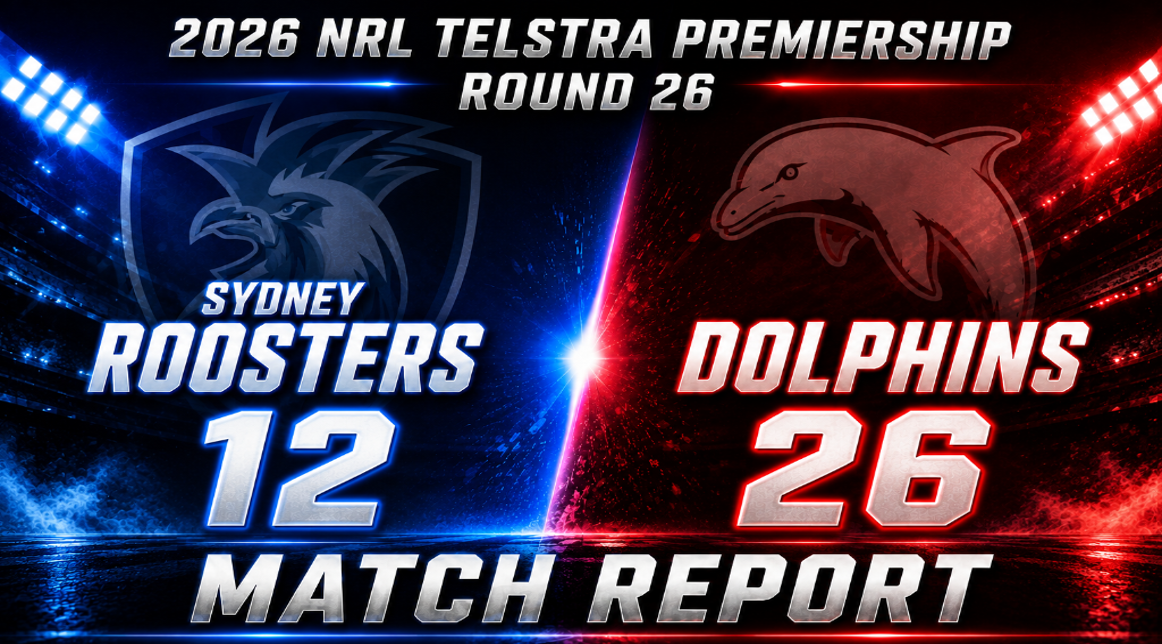
Dolphins Strengthen Top-Four Grip With 26-12 Win Over Roosters

One game to go, a top-four finish within touching distance, and the Dolphins are heading towards their first finals series with serious momentum. Kristian Woolf’s side beat the third-placed Sydney Roosters 26-12 at Allianz Stadium on Saturday, 29 August, recovering from an early deficit before taking the game apart with four tries in the final 20 minutes of the first half.

The Dolphins trailed 6-0 after Robert Toia crossed inside six minutes, but there was no repeat of the damaging slow starts that had forced them into comeback mode against Brisbane and Parramatta. Herbie Farnworth answered in the 21st minute before Selwyn Cobbo struck twice in five minutes, with Max Plath adding another just before halftime to send the Dolphins into the sheds 20-6 ahead.

Dolphins Take Control Before the Break

Sydney had the better of the opening exchanges, but the game shifted once Farnworth put the Dolphins on the board and Jamayne Isaako converted to make it 6-6.

Cobbo then took over, crossing in the 30th minute and again four minutes later as the Roosters began to come apart under pressure. Plath added another in the 39th minute, with Isaako’s conversion completing a 20-point Dolphins response after Sydney had opened the scoring.

The pressure carried into the second half, with Jeremy Marshall-King breaking through in the 48th minute before Isaako converted to stretch the lead to 26-6. It proved to be the Dolphins’ final score, but by then the Roosters needed four tries to get back in front.

Dolphins Dig In With Men in the Bin

The complexion changed in the final quarter as the Dolphins’ discipline gave Sydney a route back into the contest. Thomas Flegler was sent to the sin bin for a professional foul in the 61st minute before Morgan Knowles followed him seven minutes later after a hip-drop penalty, with Knowles also placed on report.

The Roosters capitalised through Salesi Foketi, whose converted try reduced the margin to 26-12, but that was as close as they came. Even with the Dolphins spending much of the closing stages short-handed, Sydney could not find another try and Woolf’s side closed out its fourth win from four games in Sydney this season.

Cobbo’s double did much of the damage during the decisive first-half burst, while Farnworth, Plath and Marshall-King ensured the points came from across the side. The Dolphins will have some discipline to address after the two sin bins, with Flegler and Kurt Donoghoe also placed on report during the match, but they had already done enough with the ball to withstand the late pressure.

The Dolphins came to Sydney with their top-four position under pressure and left with exactly the result they needed. Their maiden finals appearance is already secured; with one regular-season game remaining, the 26-12 win has strengthened their grip on a top-four finish and the double chance that comes with it.

Match Summary

Sydney Roosters 12 – Dolphins 26
Round 26, NRL Telstra Premiership
Saturday, 29 August 2026
Allianz Stadium, Sydney

Halftime: Roosters 6 – Dolphins 20

Roosters tries: Robert Toia, Salesi Foketi
Roosters goals: Sam Walker 1/1, Hugo Savala 1/1

Dolphins tries: Herbie Farnworth, Selwyn Cobbo (2), Max Plath, Jeremy Marshall-King
Dolphins goals: Jamayne Isaako 3/5

Sin bins: Thomas Flegler (Dolphins), Morgan Knowles (Dolphins)

On report: Thomas Flegler, Kurt Donoghoe, Morgan Knowles (Dolphins)

Published 29-August-2026

The Dolphins Roundup: Phins Land Dally M Honours and Powerhouse Recruits

It’s been a momentous week for the Dolphins. Alongside dual Dally M award victories for Herbie Farnworth and Jack Bostock, the club has announced the additions of Origin prop Daniel Saifiti and promising outside back Max Feagai for 2025, as well as securing two key assistant coaches to join incoming head coach Kristian Woolf.


Read: Vine Time Immortalised: Cortnee Vine’s Historic Penalty Honoured in Bronze


Dolphins celebrate Dally M success

The Dolphins’ impressive sophomore campaign has been recognised at the Dally M Awards, with the club securing two prestigious honours. Herbie Farnworth claimed the Centre of the Year award, while Jack Bostock was named Rookie of the Year, marking a major achievement for the young winger.

Hamiso Tabuai-Fidow was also in contention for Fullback of the Year. He was ultimately edged out by Roosters’ James Tedesco, rounding out a strong showing for the club with three nominees.

Origin prop Daniel Saifiti joins

In a major coup for the Dolphins, representative front-rower Daniel Saifiti will join the club from the Newcastle Knights. The 28-year-old veteran brings considerable experience to the forward pack, with 183 NRL games under his belt, seven State of Origin appearances for NSW, and international experience representing Fiji.

The signing reunites Saifiti with incoming head coach Kristian Woolf, his former mentor at the Knights. “He is a representative player, he is tough, aggressive, and a hard worker—all the things the Dolphins pride themselves on being,” Dolphins CEO Terry Reader said.

Alongside Saifiti, Knights assistant coach Rory Kostjasyn will also make the move north, adding valuable coaching expertise to the staff.

The Woolf pack grows

The Dolphins have further strengthened their squad by securing 23-year-old Max Feagai from the St George Illawarra Dragons. The young star joins a formidable lineup of outside backs, competing alongside the trio of Dally M nominees, as well as established players Jamayne Isaako and Trai Fuller.

Dragons assistant coach Ben Woolf will unite with his brother Kristian, who will take over the reins from Wayne Bennett.


Read: Scarborough Boat Harbour Master Plan Set to Transform Local Community


The new recruits will begin their Dolphins journey in November’s preseason, marking the start of an exciting chapter as the club builds toward 2025 with a reinforced playing and coaching roster.

Published 07-October-2024