


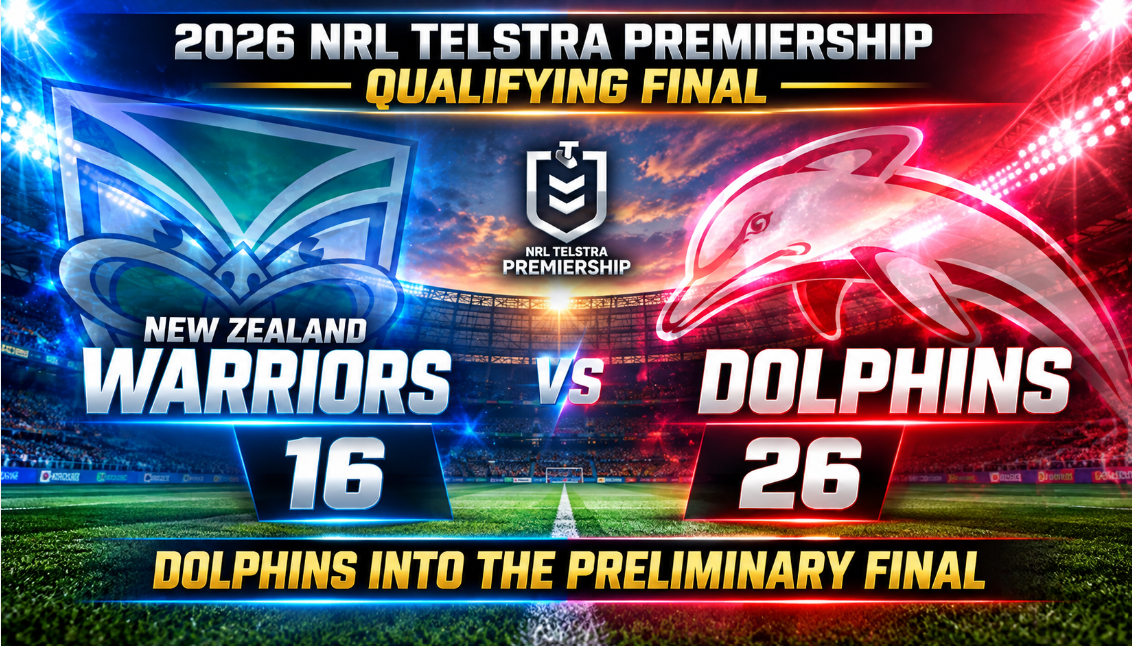
Dolphins Beat Warriors 26–16 to Reach Preliminary Final

The Dolphins are through to a preliminary final after turning an eight-point second-half deficit into a 26–16 win over the Warriors in Auckland, extending their remarkable late-season run to eight straight victories.

For almost an hour, their first NRL final was a grind. The Warriors had the crowd behind them, a lead on the scoreboard and Taine Tuaupiki steadily adding points from the kicking tee, while the Dolphins struggled to turn their opportunities into enough scoreboard pressure.

That changed in the final quarter. Herbie Farnworth crossed in the 60th minute, Hamiso Tabuai-Fidow followed six minutes later and Jack Bostock added another in the 74th, transforming a 16–8 deficit into a 26–16 victory.

It was not the free-flowing afternoon their recent scoring form might have suggested. The Dolphins instead had to stay with a finals match that became messy and frustrating before their attacking players finally found the openings they needed.


Warriors Keep the Scoreboard Moving

New Zealand were happy to take points whenever the Dolphins gave them the opportunity. Tuaupiki kicked an eighth-minute penalty before Jamayne Isaako answered four minutes later, then scored the opening try in the 15th minute and converted it himself.

Another Tuaupiki penalty made it 10–2 before Selwyn Cobbo gave the Dolphins their first try in the 25th minute. Isaako converted and, despite New Zealand having controlled much of the opening quarter, the margin was back to two.

The game then entered a chaotic stretch. Adam Pompey was sent to the sin bin in the 28th minute before Kurt Capewell and Cobbo were both binned five minutes later. Isaiya Katoa was also placed on report during the same passage.

Very little scoring came from all that disruption. Tuaupiki’s penalty on the stroke of half-time was the only further addition, sending the Warriors to the sheds 12–8 ahead.

That was largely how New Zealand had built their advantage. The teams had scored one try each, but the Warriors kept taking the two points on offer and making the Dolphins chase them.

Dolphins Stay Within Reach

The Dolphins’ habit of conceding starts had been one of the concerns heading to Auckland after their huge recoveries against Brisbane and Gold Coast. This time the deficit never became quite as alarming, although they again spent a long period playing from behind.

Tuaupiki kicked two more penalties early in the second half, stretching the Warriors’ lead to 16–8 by the 53rd minute. New Zealand had now kicked five penalty goals but still had only one try, leaving the Dolphins close enough for one productive attacking spell to change the match.

Farnworth provided it in the 60th minute, breaking through for a try that Isaako converted to make it 16–14. Six minutes later Tabuai-Fidow found his way through and Isaako’s conversion put the Dolphins ahead for the first time at 20–16.

After spending most of the afternoon trying to get back on terms, the Dolphins suddenly had New Zealand chasing them. The game had also opened enough for their dangerous runners to become a much bigger factor.

Bostock Puts It Beyond Reach

There was still plenty of time for New Zealand at 20–16, but the Dolphins looked increasingly threatening once they had the lead. Bostock had already broken the Warriors line earlier in the half and, in the 74th minute, he crossed for the try that effectively settled the contest.

Isaako’s conversion took the score to 26–16 and completed a faultless afternoon from the tee. He kicked four conversions and a penalty goal, while Cobbo, Farnworth, Tabuai-Fidow and Bostock shared the Dolphins’ four tries.

New Zealand’s scoring had a very different shape. Tuaupiki accounted for all 16 Warriors points with their only try, a conversion and five penalty goals.

Those twos had been enough to keep the Dolphins at arm’s length for much of the afternoon. Once Farnworth and Tabuai-Fidow struck six minutes apart, however, the Warriors needed tries of their own and could not find them.


A Win With Some Rough Edges

The Dolphins did not come through the afternoon without concerns. Thomas Flegler left for an HIA inside the opening 10 minutes and did not return, while Kodi Nikorima and Connelly Lemuelu were both placed on report during the second half.

Discipline also helped the Warriors accumulate their five penalty goals, and the three first-half sin bins made an already tight contest difficult to settle. Against a side able to turn more of those opportunities into tries, the Dolphins could have faced a much steeper climb.

What mattered in Auckland was that they never allowed the Warriors to get far enough away. An eight-point deficit after 52 minutes did not force them to abandon their game, and when the chances came, the players who have driven much of their late-season surge took them.

Farnworth brought the Dolphins back within two, Tabuai-Fidow put them ahead and Bostock gave them the breathing room they needed to see out the afternoon.

Eight Straight and Into the Final Four

Before the match, Auckland presented a different test of the run that had carried the Dolphins to third place. They had won seven straight, but none of those games had involved finals pressure or a trip to a ground where the Warriors had lost only twice all season.

Their eighth win looked different from many that came before it. They spent most of the match behind, lost Flegler early and had to negotiate a contest punctuated by penalties, sin bins and long periods when the Warriors controlled the scoreboard.

The decisive passage came after the hour mark. Farnworth scored in the 60th minute, Tabuai-Fidow in the 66th and Bostock in the 74th, turning an eight-point deficit into a 10-point win.

The Dolphins will now sit out next weekend before returning for a preliminary final, one victory away from a grand final appearance.

Four seasons into their NRL life, their first finals match has ended with their first finals win.

Published 12-September-2026

Seven Straight, Then Auckland: Dolphins Face Their First Finals Test

The Dolphins will take a seven-game winning streak into the first finals match in club history on Saturday, but their reward for finishing third is a trip to Auckland to face a Warriors side that has won six straight and lost only twice at Go Media Stadium this season.

The qualifying final brings together two of the competition’s form teams, with a direct passage to the preliminary finals at stake.

The Dolphins arrive after their 24–20 win over Gold Coast, a result that extended their best run of the season but also gave Kristian Woolf plenty to address. They were 14–0 down inside 16 minutes before working their way back, having also recovered from 24–0 down against Brisbane earlier in the winning streak.

Those comebacks have become part of the Dolphins’ recent story. Against the Warriors, the more useful lesson may be how much work was required after conceding those starts.

New Zealand have been scoring heavily through the closing rounds, averaging 39 points a game since Round 22, and Go Media Stadium has been one of the competition’s tougher trips. The Warriors have won eight of their 10 games there in 2026 and will host a final at the ground for the first time since their 40–10 win over Newcastle in 2023.

Little Between Them This Year

The Dolphins at least travel knowing they have already matched the Warriors twice.

New Zealand won 20–18 when the teams met in Wellington in Round 8. At Suncorp Stadium in Round 17, the Dolphins turned that result around, with Selwyn Cobbo scoring late before Jamayne Isaako landed the sideline conversion for a 26–24 victory.

Four points separated the teams across the two games.

The circumstances this time are considerably different, particularly with the Warriors at home, but those results provide a useful measure of the matchup. Neither side was able to establish clear superiority over the other during the regular season.

The Dolphins also head to Auckland in considerably better form than they were for either meeting. Their seven-match run has taken them through several different types of games, from the huge comeback against Brisbane to last week’s much tighter finish against Gold Coast.

Dolphins Welcome Back Key Trio

Woolf will also have three important players back after they missed the final round.

Cobbo returns on the wing after an ankle issue, Kodi Nikorima resumes at five-eighth after managing a hamstring problem and Kulikefu Finefeuiaki comes back into the second row following a knee issue.

Nikorima’s return reunites him with Isaiya Katoa, while Hamiso Tabuai-Fidow remains at fullback and Herbie Farnworth, Jack Bostock, Cobbo and Isaako complete a backline that has been central to the Dolphins’ late-season surge.

The Warriors have strengthened their side as well. Wayde Egan and Kurt Capewell return after being rested, Leka Halasima is back from an ankle injury and Jackson Ford has been named on the bench for his first appearance since suffering a pectoral injury in Round 16.

That leaves both teams with plenty available around the edges, although getting the opportunity to use it will depend heavily on what happens through the middle.

Plenty Riding on the Middle

James Fisher-Harris, Mitch Barnett and Erin Clark give the Warriors a strong platform, with Egan back at hooker. The Dolphins will lean heavily on Tom Flegler, Tom Gilbert and Morgan Knowles, while Max Plath and Finefeuiaki add considerable work on the edges.

For the Dolphins, holding that contest is particularly important because of what Katoa can do when he is playing on the front foot.

He has Tabuai-Fidow and Farnworth outside him, Nikorima alongside him and Cobbo and Isaako finishing on the wings. When the Dolphins are getting quick enough ball to bring those players into the game with space, there are threats across the field.

The alternative is Katoa working from deep inside his own half, with the Warriors able to set their defensive line and control where the Dolphins begin their sets.

That is where last week’s opening against the Titans becomes relevant. Gold Coast’s 14–0 lead forced the Dolphins to spend much of the first half repairing the scoreboard. They managed it, but the Warriors present a different proposition if they are given the same opportunity at home.

A Different Kind of Away Game

Finefeuiaki knows the setting better than most in the Dolphins side. The New Zealand-born forward has spoken this week about the noise expected at Go Media Stadium and the difficulty it can create for players trying to communicate.

Their record there backs up Finefeuiaki’s warning: the Warriors have lost only twice in 10 games at Go Media Stadium this season.

Their only two losses from 10 games at the ground this season have made Auckland an important part of their second-place finish, while six consecutive wins have taken them into the finals with momentum of their own.

That gives the Dolphins a fairly clear picture of what awaits them. Their recent run has included wins in difficult positions and evidence that they can score quickly enough to change games, but Saturday may require a more controlled performance than some of those victories.

A clean start, field position and the ability to stay with the Warriors through the middle would give Katoa and the Dolphins’ backline a chance to do the rest.

First Final, Bigger Opportunity

The historical significance of Saturday has been unavoidable this week, four seasons after the Dolphins entered the NRL.

Their position going into the match is more interesting than the milestone itself.

This isn’t a side that scraped into eighth and arrived simply pleased to have made September. The Dolphins finished third, have won seven consecutive games and split their two meetings with the second-placed Warriors this season.

Victory would put them straight into a preliminary final, one win from a grand final appearance. Defeat would send them home to Brisbane for a sudden-death semi-final.

The Dolphins have spent the past two months building the form that put them in this position. Saturday in Auckland is the first chance to see how much of it carries into finals football.

Match Details

New Zealand Warriors v Dolphins
2026 NRL Telstra Premiership — Qualifying Final
Saturday, 12 September 2026
4:05pm AEST / 6:05pm NZST
Go Media Stadium, Auckland

Published 11-September-2026

The Road to the Grand Final: Your 2026 Dolphins Finals Guide

Four seasons after entering the NRL, the Dolphins are heading into September from third place, with their first finals assignment taking them across the Tasman to face the second-placed New Zealand Warriors.

The qualifying final at Go Media Stadium on Saturday, 12 September offers a direct route deep into September. Win in Auckland and the Dolphins move straight into a preliminary final with a week off; lose and the double chance earned through their top-four finish keeps their season alive.

After spending their first three seasons trying to reach September, the Dolphins have finally arrived. What matters now is how far they can go.

Week One: Warriors v Dolphins

Qualifying Final
New Zealand Warriors (2nd) v Dolphins (3rd)
Saturday, 12 September
Go Media Stadium, Auckland
4.05pm AEST / 6.05pm NZ time

Both sides arrive in serious form. The Dolphins have won seven consecutive matches and the Warriors six, setting up a qualifying final between two teams carrying genuine momentum into September.

They Already Know How Close This Can Get

Their only meeting this season provided a fair indication of how little may separate them.

The Dolphins won 26–24 at Suncorp Stadium in Round 17 after Selwyn Cobbo scored late and Jamayne Isaako converted from the sideline. That gives them evidence they can break down the Warriors, although repeating it in Auckland under finals pressure is a different assignment.

The Warriors have home advantage and a powerful middle capable of restricting the Dolphins’ attacking freedom, making the contest for field position particularly important.

Three Matchups That Could Shape It

The Battle Through the Middle

James Fisher-Harris, Mitch Barnett and Erin Clark give the Warriors considerable experience and physicality through the middle. The Dolphins have plenty to answer with, but they need to earn the field position that allows their strike players to become influential.

If the Warriors consistently force the Dolphins to begin sets deep in their own half, Isaiya Katoa could spend much of the afternoon kicking from poor positions. Give him a platform further upfield and the complexion of the game changes quickly.

Katoa and the Kicking Game

Finals football places a premium on completing sets, finding grass and forcing opponents to work out of their own end, putting considerable responsibility on Katoa.

The 22-year-old has become increasingly important to the Dolphins’ attack, but Auckland may test his patience as much as his creativity. Against a Warriors side capable of punishing poor field position, knowing when to play conservatively could be as important as producing the spectacular.

Finding Space for the Strike Players

Hamiso Tabuai-Fidow and Herbie Farnworth give the Dolphins the ability to turn ordinary passages into points, while the wider backline provides Katoa with threats across the field.

The Titans saw that danger in Round 27, when the Dolphins recovered from 14–0 down to win 24–20 and Tabuai-Fidow scored twice while running for 261 metres. It was another demonstration of their attacking capacity, although repeatedly relying on recovery football would be a dangerous habit to carry into September.

The Selection Questions

The official Week One team is still to be named, with three players in particular to watch.

Cobbo missed the Titans match with an ankle problem, Kodi Nikorima was withdrawn with hamstring tightness and Kulikefu Finefeuiaki sat out with a knee issue. All three are currently listed by the NRL as targeting a return during the finals.

Their availability would bring the Dolphins considerably closer to the combinations used during their late-season run, but until the team is named, their Week One selection should not be treated as certain.

Seven Straight Into September

The Dolphins could hardly ask for a stronger form line. Seven consecutive victories have carried them into their maiden finals campaign, including wins over Parramatta and the Roosters before the 24–20 comeback against Gold Coast.

The Titans match was hardly a flawless tune-up. Gold Coast raced to a 14–0 lead inside 16 minutes and threatened again late, forcing the Dolphins to regain control and then withstand pressure to close it out.

There may be some value in having faced that immediately before the finals, but it also reinforced a concern that has followed the Dolphins through their winning run.

The Double Chance — and Why It Matters

Finishing third means defeat in Auckland would not end the Dolphins’ season. They would instead move into a sudden-death semi-final in Week Two against the winner of the Sharks-Cowboys elimination final.

Victory is far more valuable. Beat the Warriors and the Dolphins skip Week Two entirely, gaining an extra week to recover before playing a preliminary final for a place in the Grand Final.

The shortest route therefore requires three victories from here: Warriors, preliminary final, Grand Final. Lose in Auckland and an additional sudden-death match is added to the journey.

Five Reasons the Dolphins Can Go Deep

The case for the Dolphins as premiership contenders has already been built across the regular season, but several strengths matter particularly now.

Tabuai-Fidow and Farnworth provide elite strike power, while Katoa has grown increasingly comfortable directing the side. There is enough size and experience through the forwards to compete when finals football tightens up, and seven consecutive victories provide compelling evidence of current form.

Then there is their resilience. Brisbane led the Dolphins 24–0 in Round 23 before losing 40–32, while Gold Coast led 14–0 in Round 27 and lost 24–20.

Those comebacks are evidence of a team that is difficult to put away. They also point directly towards its biggest vulnerability.

The Biggest Obstacle

The Dolphins have developed an uncomfortable habit of showing how dangerous they are after making life considerably harder for themselves.

Recovering from 24 points down against Brisbane produced one of their most memorable wins of the season, and the Titans comeback sent them into September on another high. Against the strongest sides in the competition, however, those deficits can become too large to retrieve.

Their attacking talent gives them unusual capacity to rescue matches. In the finals, avoiding the need for a rescue in the first place may be more important.

What It Could Come Down To

The Warriors earned the advantage that comes with finishing second, and Auckland is about as demanding an assignment as the Dolphins could have drawn for their first finals appearance. They also enter September with six consecutive victories, so neither side has much reason to fear the other’s form.

The Dolphins have already shown they can beat this opponent, but doing it again will require something they have not always managed during their late-season surge: producing their best football without first putting themselves in trouble.

Get that part right and the reward is substantial. A victory in Auckland would deliver a week off and leave the Dolphins one win from the Grand Final.

For a club entering its first finals campaign only four seasons after joining the NRL, that is already remarkable territory. From here, though, the story is no longer about how quickly the Dolphins got here.

It is about what they do now.

Published 7-September-2026

Four Years to September: How the Dolphins Built Their First Finals Team

It took the Dolphins just four seasons to go from a blank NRL team sheet to September. What began with Wayne Bennett, a collection of hardened veterans and a handful of calculated gambles has evolved into the club’s first finals team — and one that looks very different from the side that started it all.

When the Dolphins were awarded the NRL’s 17th licence in October 2021, the new franchise carried the history of a Redcliffe club founded in 1947 but deliberately entered the competition without the suburb in its name.

The ambition extended well beyond the peninsula. NRL chief executive Andrew Abdo said the Dolphins could reach from Brisbane’s northern corridor through Moreton Bay and towards the Sunshine Coast, giving the club a much broader footprint from which to build its support.

Wayne Bennett was appointed foundation coach eight days later and faced the considerable task of assembling an NRL roster from scratch. The recruitment strategy that followed leaned heavily on experience: Felise Kaufusi became the inaugural signing before Jesse and Kenny Bromwich and Mark Nicholls joined a forward pack carrying premiership success, representative experience and hundreds of first-grade games.

Alongside them were two younger recruits whose importance would become clearer with time. Isaiya Katoa was only 18 when the Dolphins signed him from Penrith, while Hamiso Tabuai-Fidow arrived from North Queensland with an opportunity to establish himself at fullback. Four seasons later, both are central figures in the first Dolphins side bound for September.

An Opening That Changed Expectations

Few expansion teams get an introduction quite like the Dolphins did.

More than 32,000 people were at Suncorp Stadium on 5 March 2023 when they faced the Sydney Roosters, with the occasion carrying an added connection through Arthur Beetson, the rugby league Immortal who had represented both Redcliffe and the Roosters.

The Dolphins won 28–18 and quickly showed it was more than an opening-day flourish, winning seven of their first 12 matches and sitting sixth after Round 13. The demands of a full NRL season eventually exposed the limitations of a new roster, however, and they finished 13th with nine wins and 15 losses, scoring 520 points while conceding 631.

Thirteenth place hardly suggested an immediate finals contender, but the first season had answered the more fundamental question confronting any expansion club. The Dolphins had demonstrated quickly that they could compete at NRL level, and expectations began moving accordingly.

One Game Short — and the End of the Foundation Era

By the end of 2024, credibility was no longer the benchmark.

The Dolphins entered Round 27 knowing victory over Newcastle would put them into the finals in only their second season. Instead, the Knights won 14–6 and claimed eighth place, leaving the Dolphins 10th with an 11–13 record.

The defeat also drew a line under the club’s foundation era. Bennett departed after two seasons, Kristian Woolf moved from assistant to head coach and inaugural captain Jesse Bromwich retired.

Bennett later credited Bromwich, his brother Kenny, Kaufusi and Nicholls with helping establish the standards required inside a new NRL club. Their recruitment had given the Dolphins something an expansion side could not develop overnight: players who already knew what successful NRL environments looked like.

Woolf inherited those foundations, but the next stage required the Dolphins to become less dependent on the generation recruited to establish them.

The 721-Point Season That Still Wasn’t Enough

The answer in 2025 was spectacular in attack and costly at the other end of the field.

In Woolf’s first season as head coach, the Dolphins scored 721 points, the best attacking return in the NRL, while Jamayne Isaako led the competition with 278 points. For all that attacking production, they conceded 596 and finished ninth with a 12–12 record.

According to rugby league historian David Middleton, they became the first team since Western Suburbs in 1924 to lead the competition in points scored and still miss the post-season.

The problem became particularly stark late in the season. Across successive matches against the Roosters, Broncos and Sea Eagles, the Dolphins conceded 36, 38 and 58 points. A side capable of scoring at a premiership-threatening rate had been left outside the eight because it could not consistently contain opponents.

That contradiction became one of the defining lessons carried into 2026. The Dolphins did not need to reinvent an attack that had already led the competition; they needed to become considerably harder to beat.

Woolf Builds a More Complete Dolphins Side

Defence, fitness and physical resilience were consequently prominent themes heading into Woolf’s second season, but the change since 2023 has involved considerably more than tightening the numbers without the ball.

Katoa has developed from an 18-year-old investment into the halfback entrusted with directing the team. Tabuai-Fidow has become one of the club’s defining players, while Max Plath went from joining the Dolphins in 2023 and making his NRL debut that season to winning the 2024 Arthur Beetson Medal and making his Queensland debut in 2026.

Isaako’s career revival has added another strand to that development, while the roster has been strengthened progressively rather than rebuilt in one hit. Daniel Saifiti and Kulikefu Finefeuiaki arrived for 2025, with Morgan Knowles, Selwyn Cobbo and Brad Schneider among the additions for 2026.

It is a significantly different model from the one Bennett needed in 2023. The inaugural Dolphins relied on established players to import experience and standards; the current side increasingly combines that foundation with players whose best football has been developed or produced during the club’s own short NRL life.

The Comeback That Finally Took Them to September

The breakthrough arrived in a Battle of Brisbane that initially looked like becoming one of the Dolphins’ worst nights of the season.

Brisbane raced to a 24–0 lead at Suncorp Stadium on 8 August before the Dolphins overturned the deficit to win 40–32, securing the first finals appearance in the club’s NRL history.

There was another indication of their progress three weeks later at Allianz Stadium. Forced to defend periods with 12 men and then 11 against the Roosters, the Dolphins conceded only 12 points and won 26–12. It was their 16th victory of the season and moved them to third on the ladder with one regular-season match remaining.

Through Round 26, the Dolphins have scored 612 points and conceded 474. The attack remains among the club’s great strengths, but the broader change is reflected in the outcome: 16 wins already, compared with 12 across the entire 2025 regular season.

Four Seasons, a Different Measure of Success

Four years ago, the Dolphins were an expansion gamble — a new NRL side built around hardened veterans and young talent that might or might not deliver.

Now the gamble is paying off.

The Dolphins are heading to September for the first time, and the players once recruited on potential are increasingly the ones driving them there. Katoa, Tabuai-Fidow and Plath are no longer prospects around an experienced foundation; they are part of the core of a finals team.

That is how far this club has moved in four seasons. The question is no longer whether the Dolphins belong in the NRL. It is how far they can go.


Published 30-August-2026